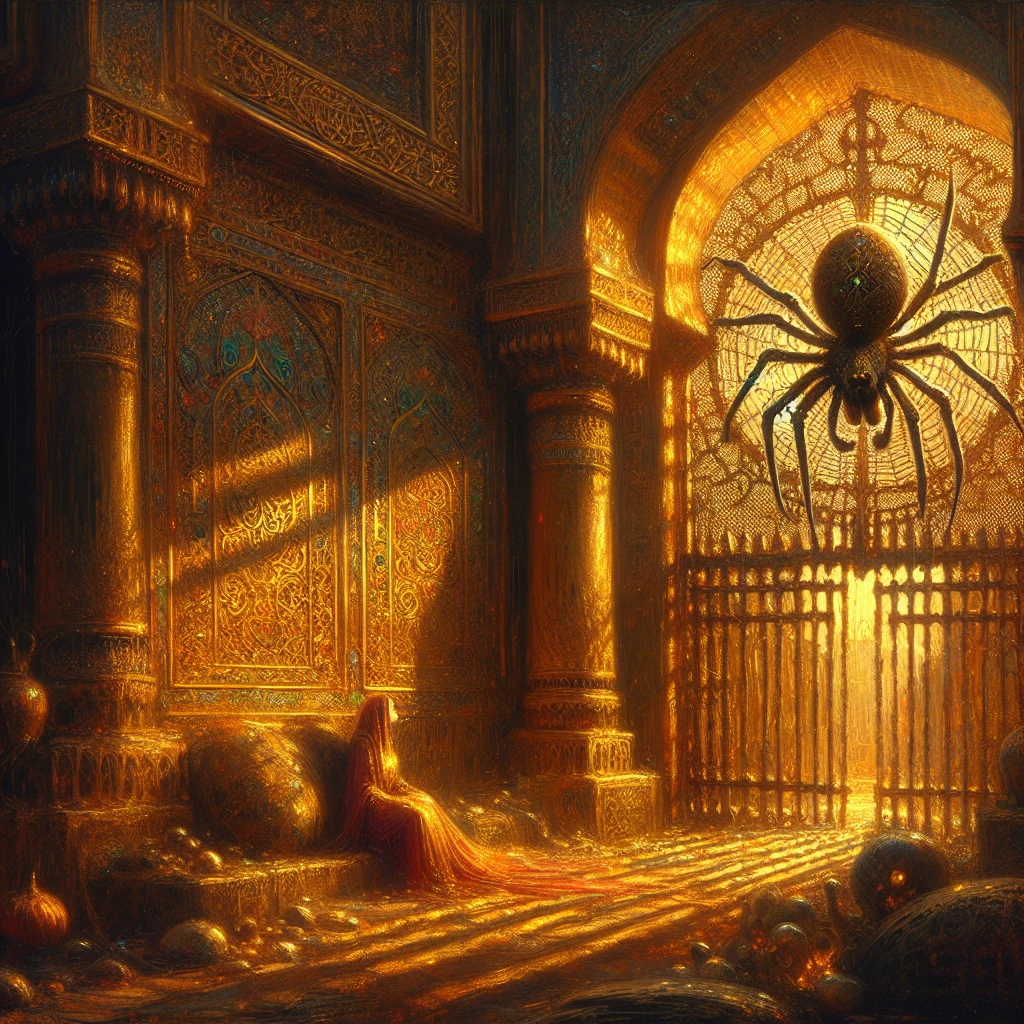
A Spider once attached herself to a high gate and a retired and span her web there and dwelt within it in peace, giving thanks to the Almighty, who had made this dwelling place easy to her and had set her in safety from noxious reptiles. in this way she abode a long while, still giving thanks to Allah for her ease and regular supply of daily bread, till her Creator bethought Him to try her and make essay of her gratitude and patience. So he sent upon her a strong east Wind, which carried her away, web and all, and cast her into the main. The waves washed her ashore and she thanked the Lord for safety and began to upbraid the Wind, saying, "O Wind, why have you dealt thus with me and what good have you gotten by bearing me here from my abiding place, where indeed I was in safety, secure in my home on the top of that gate?" Replied the Wind, saying, "O Spider, have you not learnt that this world is a house of calamities; and, say me who can boast of lasting happiness that such portion shall be yours? Wottest you not that Allah tempts His creatures in order to learn by trial what may be their powers of patience? How, then, does it beset you to upbraid me, you who have been saved by me from the vasty deep?" "Your words are true, O Wind," replied the Spider, "yet not the less do I desire to escape from this stranger land into which your violence has cast me."
The Wind rejoined, "Cease your blaming; for right soon I will bear you back and replace you in your place, as you were afore time." So the Spider waited patiently, till the north east Wind left blowing and there arose a south west Wind, which gently caught her up and flew with her towards her dwelling place; and when she came to her abode, she knew it and clung to it. "And we," continued the Wazir, "beseech Allah (who has rewarded the King for his singleness of heart and patience and has taken pity on his subjects and blessed them with His favour and has vouchsafed the King this son in his old age, after he had despaired of issue and removed him not from the world, till He had blessed, him with coolth of eyes and bestowed on him what He has bestowed of Kingship and Empire!) to vouchsafe unto your son that which He has vouchsafed unto you of dominion and Sultanship and glory! Amen." Then said the King, "Praised be Allah over all praise and thanks be to Him over all thanks! There is no god but He, the Creator of all things, by the light of whose signs we know the glory of His greatness and who gives kingship and command over his own country to whom He wills of His servants! He chooses of them whomso He please to make him His viceroy and viceregent over His creatures and commands him to just and equitable dealing with them and the maintenance of religious laws and practices and right conduct and constancy in ordering their affairs to that which is most acceptable to Him and most grateful to them. whoever does thus and obeys the commandment of his Lord, his desire attains and the orders of his God maintains; so Providence preserves him from the perils of the present world and makes ample his recompense in the future world; for indeed He neglects not the reward of the righteous. And whoever does otherwise than as Allah bids him sinns mortal sin and disobeys his Lord, preferring his mundane to his supra mundane weal. He has no trace in this world and in the next no portion: for Allah spars not the unjust and the mischievous, nor does He neglect any of His servants. These our Wazirs have set forth how, by reason of our just dealing with them and our wise governance of affairs, Allah has vouchsafed us and them His grace, for which it behoves us to thank Him, because of the great abundance of His mercies: each of them has also spoken that wherewith the Almighty inspired Him concerning this matter, and they have vied one with another in rendering thanks to the Most High Lord and praising Him for His favours and bounties. I also render thanks to Allah for that I am but a slave commanded; my heart is in His hand and my tongue in His subjection, accepting that which He adjudgs to me and to them, come what may of it. Each one of them has said what passed through his mind on the subject of this boy
King Jali'ad Of Hind And His Wazir Shimas. 61 and has set forth that which was of the renewal of divine favour to us, after my years had reached the term when confidence fails and despair assails. So praised be Allah who has saved us from disappointment and from the altenation of rulers, like to the alternation of night and day! For truly, this was a great boon both to them and to us; where fore we praise Almighty Allah who has given a ready answer to our prayer and has blessed us with this boy and set him in high place, as the inheritor of the kingship. And we entreat Him, of His bounty and clemency, to make him happy in his actions, prone to pious works, so he may become a King and a Sultan governing his people with justice and equity, guarding them from perilous error and frowardness, of His grace, goodness and generosity!" When the King had made an end of his speech, the sages and Olema rose and prostrated themselves before Allah and thanked the King; after which they kissed his hands and departed, each to his own house, whilst Jali'ad withdrew into his palace, where, he looked upon the newborn and offered up prayers for him and named him Wird Khán. The boy grew up till he attained the age of twelve, when the King being minded to have him taught the arts and sciences, bade build him a palace In the very middle of the city, in which were three hundred and threescore rooms, and lodged him within it.
Then he assigned him three wise men of the Olema and bade them not be lax in teaching him day and night and look that there was no kind of learning but they instruct him within it, so he might become versed in all knowledge. He also commanded them to sit with him one day in each of the rooms by turn and write on the door of it that which they had taught him within it of various kinds of lore and report to himself, every seven days, whatever instructions they had imparted to him. So they went in to the Prince and did not stop from educating him day nor night, nor withheld from him anything of that they knew; and presently there appeared in him readiness to receive instruction such as none had shown before him. Every seventh day his governors reported to the King what his son had learnt and mastered, by which Jali'ad became proficient in goodly learning and fair culture, and the Olema said to him, "Never saw we one so richly gifted with understanding as is this boy: Allah bless you in him and give you joy of his life!" When the Prince had completed his twelfth year, he knew the better part of every science and excelled all the Olema and sages of his day: Why his governors brought him to his sire and said to him, "Allah gladden yours eyes, O King, with this auspicious youth! We bring him to you, after he has learnt all manner knowledge and there is not one of the learned men of the time nor a scientist who has attained to that whereto he has attained of science."
The King rejoiced in this with joy exceeding and thanking the Almighty prostrated himself in gratitude before Allah (to whom belong Majesty and Might!), saying, "Laud be to the Lord for His mercies incalculable!" Then he called his Chief Wazir and said to him, "Know, O Shimas, that the governors of my son are come to tell me that he has mastered every kind of knowledge and there is nothing but they have instructed him within it, so that he surpasses in this all who forewent him. What sayst you, O Shimas?" at this the Minister prostrated himself before Allah (to whom belong Might and Majesty!) and kissed the King's hand, saying, "Loath is the ruby stone, albe it be bedded in the hardest rock on hill, to do anything but shine as a lamp, and this your son is such a gem; his tender age has not hindered him from becoming a sage and praise be to God—praised be Allah—for that which He deigned bestow on him! But to morrow I will call an assembly of the flower of the Emirs and men of learning and examine the Prince and cause him speak forth that which is with him in their presence, God willing!"—
When it was the Nine Hundred and ninth night
She pursued, when the King Jali'ad heard the words of his Wazir Shimas, he commanded the attendance of the keenest witted of the Olema and most accomplished of the learned and sages of his dominions, and they all presented themselves
King Jali'ad Of Hind And His Wazir Shimas. 63 on the morrow at the door of the palace, whereupon the King bade admit them. Then entered Shimas and kissed the hands of the Prince, who rose and prostrated himself to the Minister: but Shimas said, "It behoves not the lion whelp to prostrate himself to any of the wild beasts, nor besitts it that Light prostrate itself to shade." the Prince "Whenas the lion whelp sees the leopard, he rises up to him and prostrats himself before him, because of his wisdom, and Light prostrats itself to shade for the purpose of disclosing that which is therewithin." said Shimas "True, O my lord; but I would have you answer me anent whatever I shall ask you, by leave of His Highness and his subjects." And the youth said, "And I, with permission of my sire, will answer you." So Shimas began and said, "Tell me what is the Eternal, the Absolute, and what are the two manifestations of it and whether of the two is the abiding one?" Answered the Prince, "Allah (to whom belong Might and Majesty!) is the Eternal, the Absolute; for that He is Alpha, without beginning, and Omega without end.
Now his two manifestations are this world and the next? and the abiding one of the two is the world to come." (¿) "You sayst truly and I approve your reply: but I would have you tell me, how know you that one of Allah's manifestations is this world and the other the world to come?"—"I know this because this world was created from nothingness and had not its being from any existing thing; Why its affair is referable to the first essence. Moreover, it is a commodity swift of ceasing, the works whereof call for requital of action and this postulats the reproduction of whatever passes away: so the next world is the second manifestation." (¿) "Now inform me how know you that the world to come is the abiding one of the two existences?"—"Because it is the house of requital for deeds done in this world prepared by the Eternal sans surcease." (¿) "Who are the people of this world most to be praised for their practice?" "Those who prefer their weal in the world to come before their weal in this world." (¿) "And who is he that preferrs his future to his present welfare?"—"He who knows that he dwells in a perishing house, that he was created but to vade away and that, after vading away, he will be called to account; and indeed, were there in this world one living and abiding for ever, he would not prefer it to the next world." (¿) "Can the future life subsist permanently without the present?"—"He who has no present life has no future life: and indeed I liken the world and its folk and the goal to which they fare with certain workmen, for whom an Emir builds a narrow house and lodgs them within it, commanding each of them to do a certain task and assigning to him a set term and appointing one to act as steward over them. whoever does the work appointed unto him, the steward brings him forth of that straitness; but whoever does it not within the stablished term is punished.
After awhile, behold, they find honey exuding from the chinks of the house, and when they have eaten of it and tasted its sweetness of savour, they slacken in their ordered task and cast it behind their backs. So they patiently suffer the straitness and distress in which they are, with what they know of the future punishment whereto they are fast going, and are content with this worthless and easily won sweetness: and the Steward leavs not to fetch every one of them forth of the house, for ill or good, when his appointed period shall have come. Now we know the world to be a dwelling in which all eyes are dazed, and that each of its folk has his set term; and he who finds the little sweetness that is in the world and busies himself therewith is of the number of the lost, since he preferrs the things of this world to the things of the next world: but whoever pays no heed to this poor sweetness and preferrs the things of the coming world to those of this world, is of those who are saved." (¿) "I have heard what you say of this world and the next and I accept yours answer; but I see they are as two placed in authority over man; needs must he content them both, and they are contrary one to other. So, if the creature set himself to seek his livelihood,
The Two Kings. 65 it is harmful to his soul in the future: and if he devote himself to the next world, it is hurtful to his body; and there is no way for him of pleasing these two contraries at once."—"Indeed, the quest of one's worldly livelihood with pious intent and on lawful wise is a viaticum for the quest of the goods of the world to come, if a man spend a part of his days in seeking his livelihood in this world, for the sustenance of his body, and devote the rest of his day to seeking the goods of the next world, for the repose of this soul and the warding off of hurt from it; and indeed I see this world and the other world as they were two Kings, a just and an unjust." Asked Shimas, "How so?" and the youth began the tale of