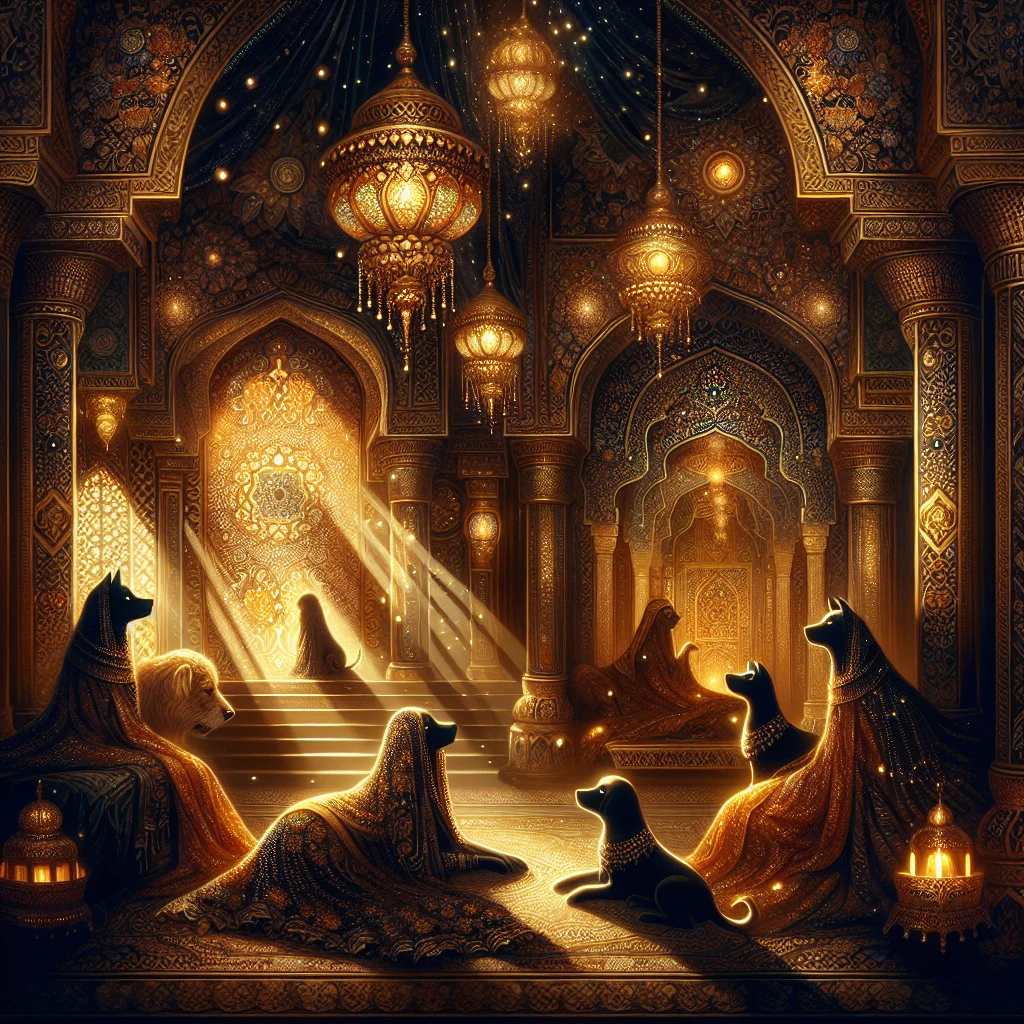
Truly, mine is a strange tale: two black bitches are my eldest sisters by one mother and father, and these two others—she who bears upon her the signs of stripes and the third, our procuratrix—are my sisters by another mother. When my father died, each took her share of the inheritance, and after a time my mother also passed away, leaving me and my sisters a sum of three thousand dinars. So each daughter received a portion of a thousand dinars, as did I, though I was the youngest. In time, my sisters married with great ceremony and lived with their husbands, who purchased merchandise with their wives' dowries and set out on trading voyages together. Thus they left me behind. My brothers-in-law were absent with their wives for five years, and in that time they squandered all their money, became bankrupt, and abandoned my sisters in foreign lands among strangers. After five years, my eldest sister returned to me dressed in beggar's rags, her clothes torn and tattered, wearing a dirty old mantilla—truly in the most wretched and pitiable condition. At first I did not recognise her, but presently I did and asked, "What has brought you to this state?"
She answered, "O my sister, words cannot undo what is done, and Destiny's pen has written what Allah decreed." I sent her to the bath, dressed her in one of my own garments, made her a nourishing broth, and brought her wine, saying to her, "O my sister, you are the eldest and hold the place of our father and mother among us. As for the inheritance that came to me as to you, Allah has blessed it and granted it increase. My circumstances are comfortable, for I have earned much money by spinning and cleaning silk. I and you will share my wealth equally." I treated her with all kindness, and she remained with me a whole year, during which we could not stop thinking of our other sister. Shortly after, she too came home in an even more wretched condition than the first, and I treated her still more generously, giving each of them a share of my wealth. After a time they said to me, "O our sister, we desire to marry again, for we cannot bear to live our days without husbands and to lead the lives of widow." I replied, "My dear ones, you have seen little happiness in wedlock. Nowadays good men have become rare, and I do not think your plan wise, since you have already tried marriage and found it wanting."
But they would not listen to my advice and married without my consent. Nevertheless, I provided them with trousseau and dowries from my own means, and they departed with their new husbands. In very little time, their husbands deceived them, took whatever they could seize, and fled, abandoning them. My sisters then returned to me, ashamed and wretched, asking forgiveness: "Pardon our error, and do not be angry with us. Though you are younger in years, you are older in wisdom. From now on we will never speak of marriage again. Take us back as your handmaidens, that we may earn our bread." I said, "Welcome to you both. Nothing is dearer to me than you." And I took them in and showed them even greater kindness. We lived together this way for a full year, and then I resolved to sell my goods abroad. I outfitted a large ship for Bassorah, loading it with merchandise and valuable goods for trade, as well as provisions and all that was needed for the voyage. I said to my sisters, "Will you stay at home while I travel, or would you prefer to accompany me?" They answered, "We will travel with you, for we cannot bear to be separated from you."
I divided my money into two parts—one to go with me and one to remain in trusted hands, for I thought to myself, "Should some accident befall the ship, we might yet survive, and we will have something to rely upon when we return." I took my two sisters, and we embarked on a voyage that lasted many days and nights. But the ship's master was careless and lost his course. We entered a sea different from the one we sought, and for a time we did not realise this. The wind favoured us for ten days, after which the lookout went aloft and cried out, "Good news!" He came down rejoicing and said, "I have sighted what appears to be a city—like a pigeon in the distance." At this we rejoiced, and within an hour, the buildings came into view. We asked the Captain, "What city is that?" He answered, "By God, I do not know, for I have never seen it before and have never sailed these seas in my life. But since we have arrived safely, you may go ashore with your merchandise. If you find it profitable to sell, do so; if not, we will rest here for two days, replenish our supplies, and depart."
We entered the port, and the Captain went into the city and was gone for some time. When he returned, he said, "Come, go up into the city and marvel at the works of Allah among His creatures, and pray to be preserved from His righteous wrath!" We landed and went up into the city. At the gate we saw men holding staves in their hands, but when we drew near, behold! They had been turned to stone by the anger of Allah. We entered the city and found that all who dwelt in it had been transformed into black stones. Not a single inhabited house remained, nor any sign of life or fire. We were struck with awe at the sight and walked through the market streets, where we found goods, gold, and silver lying in their places undisturbed. We rejoiced and said, "Surely there is some mystery here." We dispersed throughout the streets, each gathering wealth and riches with little thought for companions or others. As for myself, I went up to the castle, which was strongly fortified. Entering the King's palace through a gate of red gold, I found all manner of gold and silver vessels. The King himself sat in the midst of his Chamberlains, Governors, Emirs, and Wazirs, all clothed in garments of exquisite beauty. I drew near and saw him seated upon a throne encrusted and inlaid with pearls and gems, his robes made of gold cloth adorned with jewels of every kind, each one flashing like a star. Around him stood fifty Mamelukes, white slaves dressed in silks of various kinds, each holding a drawn sword. Yet when I approached them, they too were black stones. My mind reeled at the sight, but I continued on and entered the great hall of the Harim. Its walls were hung with tapestries of gold-striped silk, and the floor was spread with silken carpets embroidered with golden flowers. There I saw the Queen lying at full length, arrayed in robes adorned with fresh pearls. Upon her head was a diadem set with many kinds of gems, and around her neck hung collars and necklaces. All her garments and ornaments were in their natural state, yet she too had been turned into a black stone by God's wrath.
Presently, I spotted an open door and went toward it. A flight of seven steps led upward, which I climbed until I came to a place with marble walls, hung with gold-worked carpets and tapestries. In the very centre stood a throne of juniper wood inlaid with pearls and precious stones and set with emerald bosses. In the far wall was an alcove whose curtains, strung with pearls, were drawn closed. I saw light coming from within, so I drew near and found the source—a precious stone as large as an ostrich egg, set at the upper end of the alcove on a small couch of ivory and gold. This jewel blazed like the sun, casting its rays in all directions. The couch was spread with silken fabrics of amazing richness and beauty. I marvelled greatly at all this, especially seeing candles burning brightly in that place, and I thought to myself, "Someone must have lighted these candles." I then went forth and explored the kitchen, the pantry, and the King's treasure chambers. I continued pacing from room to room, lost in wonder and awe at these marvels, absorbed in thought until night fell. Wanting to leave, but knowing not which way to go, I lost my way and returned to the alcove, where the lighted candles guided me. I sat down upon the couch, wrapped myself in a coverlet, and recited something from the Koran. Though I tried to sleep, I could not, for restlessness gripped me. When midnight came, I heard a voice chanting the Koran in the sweetest tones, though the voice was weak. Glad to hear the silence broken, I rose and followed the sound until I reached a small room whose door stood slightly ajar. Peeping through the opening, I saw it was an oratory with a prayer niche, two candles burning, and lamps hanging from the ceiling. A prayer carpet was spread upon the floor, and upon it sat a youth of fair countenance. Before him
The Eldest Lady's Tale 167 stood a copy of the Koran, from which he was reading. I marvelled to see him alone alive in that city of the dead. I entered and greeted him, and he raised his eyes and returned my greeting. I said, "By the truth of what you read in Allah's Holy Book, I beseech you to answer my question." He smiled and said, "O handmaid of Allah, first tell me what has brought you here, and I in turn will tell you what has befallen me and the people of this city, and why I alone have been spared." So I related my story, and he listened with wonder. I then asked him about the city's people, and he replied, "Bear with me a moment, O my sister." He reverently closed the Holy Book and placed it in a satin bag. Then he seated me beside him. I looked at him, and behold! He was like the full moon—fair of face, rare of form, slender and graceful, of perfect height, with cheeks bright and luminous. In short, he was most lovely, even as the poet says of one like him:
That night th' astrologer a scheme of planets drew, And lo! a graceful shape of youth appeared in view: Saturn had stained his locks with Saturninest jet, And spots of nut brown musk on rosy side face blew: Mars tinctured either cheek with tinct of martial red; Sagittal shots from eyelids Sagittarius threw: Dowered him Mercury with bright mercurial wit; Bore off the Bear what all man's evil glances grew: Amazed stood Astrophil to sight the marvel birth When louted low the Moon at full to kiss the Earth.
And of a truth Allah the Most High had robed him in the raiment of perfect grace and had purfled and fringed it with a cheek all beauty and loveliness, even as the poet says of such an one:—
By his eyelids shedding perfume and his fine slim waist I swear, By the shooting of his shafts barbed with sorcery passing rare; By the softness of his sides, and glances' lingering light; And brow of dazzling day tide ray and night within his hair By his eyebrows which deny to who look upon them rest, Now bidding now forbidding, ever dealing Joy and care; By the rose that decks his cheek, and the myrtle of its moss; By jacinths bedded in his lips and pearl his smile lays bare; By his graceful bending neck and the curving of his breast; Whose polished surface bears those granados, lovely pair By his heavy hips that quiver as he passes in his pride; Or he rests with that waist which is slim beyond compare; By the satin of his skin, by that fine unsullied sprite; By the beauty that contains all things bright and debonair; By that ever open hand; by the candour of his tongue; By noble blood and high degree whereof he's hope and heir Musk from him borrows muskiness she loves to exhale And all the airs of ambergris through him perfume the air; The sun, I think, the broad bright sun, before my love would pale And sans his splendour would appear a paring of his nail.
I looked upon him with a single glance that caused me a thousand sighs, and my heart was captivated at once. I asked him, "O my lord and my love, tell me what I questioned you about." He answered, "To hear is to obey. Know, O handmaid of Allah, that this city was the capital of my father, the King whose stone likeness you saw upon the throne, transformed by God's wrath. The Queen you found in the alcove is my mother. They and all the people of this city were Magians who worshiped fire instead of the Almighty Lord. They swore by flame and heat, by shadow and light, and by the revolving spheres of day and night. My father had no son until late in his life, when he was blessed with me. He raised me and nurtured me until I grew to manhood, and prosperity blessed me in all things.
The Eldest Lady's Tale. 169
Now it happened that there was among us an old woman, well advanced in years, a Muslim woman who inwardly believed in Allah and His Prophet, yet outwardly conformed to the religion of my people. My father trusted her completely, knowing her to be trustworthy and virtuous, and treated her with ever-increasing kindness, believing her to share his faith. When I reached manhood, my father entrusted me to her care, saying, "Take him and educate him. Teach him the rules of our faith and give him the best instruction. Do not cease in your care of him." She took me and taught me the tenets of Islam, the proper ablutions and the five daily prayers, and made me memorise the Koran, often repeating, "Serve none but Allah the Almighty!" When I had learned these teachings, she said to me, "O my son, keep this hidden from your father and tell him nothing, lest he slay you." So I concealed it from him and lived this way for some time, until the old woman died. After her death, the people of the city increased in their impiety, arrogance, and error. One day, while they were as usual, a loud and terrible sound was heard, and a crier called out in a voice like roaring thunder so that all could hear, near and far: "O people of this city, abandon your fire worship and adore Allah, the Merciful King!" At this, fear and terror seized the citizens. They rushed to my father, who was their King, and asked him, "What is this awesome voice we have heard? It has filled us with terror!" He answered, "Do not let a voice frighten you or shake your resolve. Do not turn back from the faith that is right." Their hearts were swayed by his words, and they did not abandon their fire worship. They persisted in rebellion for a full year from when they heard the first voice. On the anniversary, a second cry came, and a third at the end of the third year, each year once.
Still they persisted in their wicked ways until one day, at dawn, judgment and the wrath of Heaven descended upon them suddenly. By God's visitation, they were all metamorphosed into black stones—they, their beasts, and their cattle. None was saved except myself, who was engaged in prayer at that moment. From that day to this I have lived as you see me, constant in prayer and fasting, reading and reciting the Koran. But I have grown weary with loneliness, having no companion." Then I said to him—for truly he had won my heart and had become the lord of my life and soul—"O youth, will you come with me to Baghdad and visit the learned scholars and doctors of divinity? You will gain greater wisdom and understanding of theology. Know that I, though head of my family and mistress over men, eunuchs, servants, and slaves, will be your handmaid. My life was empty before I met you. I have a ship laden with merchandise here, and truly, Destiny has guided me to this city so that we might meet, for it was written that we should find each other." I did not cease persuading and pleading with him until he finally consented.
When it was the Eighteenth night
She slept that night at his feet, so full of joy she scarcely knew where she was. As soon as morning dawned (she continued, addressing the Caliph), I rose, and we entered the treasuries and took whatever was light in weight yet great in value. Then we made our way down from the palace to the city, where the Captain, my sisters, and the slaves who had been searching for me met us.
When they saw me, they rejoiced and asked what had kept me. I told them all I had seen and recounted the story of the young Prince and how the citizens had been justly transformed. All marvelled at this, but when my two sisters—these two bitches, O Commander of the Faithful!—saw me standing beside my young love, they became jealous and angry and plotted mischief against me. We waited for a favourable wind and boarded the ship, rejoicing and eager to depart with the goods we had gathered. But my greatest joy was in the youth. When a fair wind came, we set sail and departed. As we sat talking, my sisters asked me, "And what will you do with this handsome young man?" I answered, "I intend to make him my husband." Then I turned to him and said, "O my lord, I have a proposal for you, which you must not refuse. When we reach Baghdad, my native city, I wish to marry you according to the law, and you will be my husband while I am your wife." He answered, "I hear and obey. You are my lady and my mistress, and I will not gainsay whatever you do."
Then I said to my sisters, "This is my prize. I am content with this youth, and whatever property you have gained, keep it with my blessing." They answered, "You speak and act well," but they plotted evil against me. We sailed on with a fair wind, leaving the sea of peril behind for safer waters. Within a few days, we arrived at Bassorah city, whose buildings came into view as evening fell. But after we had retired to our quarters and were sound asleep, my two sisters arose. They took me from my bed and threw me into the sea. They did the same to the young Prince, who could not swim and sank, drowning. Allah enrolled him among the noble martyrs. As for me, I wish I had drowned with him, but Allah decreed that I should be saved. When I awoke in the sea and saw the ship fleeing like lightning, He sent me a piece of timber to hold onto. The waves tossed me back and forth until they cast me upon an island shore, a high and uninhabited land. I landed and walked about the island through the rest of the night. When morning came, I saw a rough track, barely fit for a person to walk, leading to a shallow ford that connected the island to the mainland.
As soon as the sun rose, I spread my garments to dry in its rays, ate the fruits of the island, and drank of its waters. Then I set out along the path and did not stop walking until I reached the mainland. When there was but two hours' journey between me and the city, a great serpent—as large as a date palm—came fleeing toward me at great speed, writhing to the right and left until she was nearly upon me, her tongue hanging out a span's length and sweeping the dust. She was pursued by a Dragon not longer than two lances, slender as a spear. Though her terror gave her speed and she twisted from side to side, he overtook her and seized her by the tail. Her tears streamed down and her tongue was thrust out in agony. I took pity on her and, picking up a stone and calling upon Allah for aid, threw it at the Dragon's head with such force that he died on the spot. The serpent opened a pair of wings and flew into the sky, disappearing from before my eyes. I sat down marvelling at this adventure, but weariness overcame me, and I slept where I was for a while. When I awoke, I found a jet-black damsel sitting at my feet, massaging them, and beside her stood two black bitches—my sisters, O Commander of the Faithful! I was ashamed and, sitting up, he asked, "O my sister, who are you and what is your nature?" She answered, "Have you forgotten me so soon? I am she whom you helped and showed kindness to, and whose enemy you slew. I am the serpent, and by God's help
Tale of the Portress. 173 you delivered me from the Dragon. I am a Jinni woman, and he was a Jinn who hated me. No one but you saved my life from him. As soon as you freed me, I flew on the wind to the ship from which your sisters threw you, and I removed all that was within it and brought it to your house. Then I ordered my servants, the Marids, to sink the ship, and I transformed your two sisters into these black bitches. I know all that has passed between them and you. As for the youth, he is truly drowned." So saying, she flew up with me and the bitches, and soon set us down on the terrace of my house, where I found all the property that had been in my ship, and not a single thing was missing. "Now," continued the serpent woman, "I swear by all that is engraved upon the seal ring of Solomon—peace be upon him—that unless you give each of these bitches three hundred stripes every day, I will come and imprison you forever beneath the earth." I answered, "I hear and obey," and she flew away. But before leaving, she charged me again, saying, "I swear again by Him who made the two seas flow—this is my second oath—that if you disobey me, I will come and transform you like your sisters." Since then, O Commander of the Faithful, I have never failed to beat them with that number of blows until their blood flows and my tears fall, though I pity them even as I strike them. They know their beating is not my fault, and they accept my sorrow for them. And this is my tale and my history!" The Caliph marvelled at her adventures and then signalled to Ja'afar, who said to the second lady, the Portress, "And you, how came you by the welts and marks upon your body?" And she began